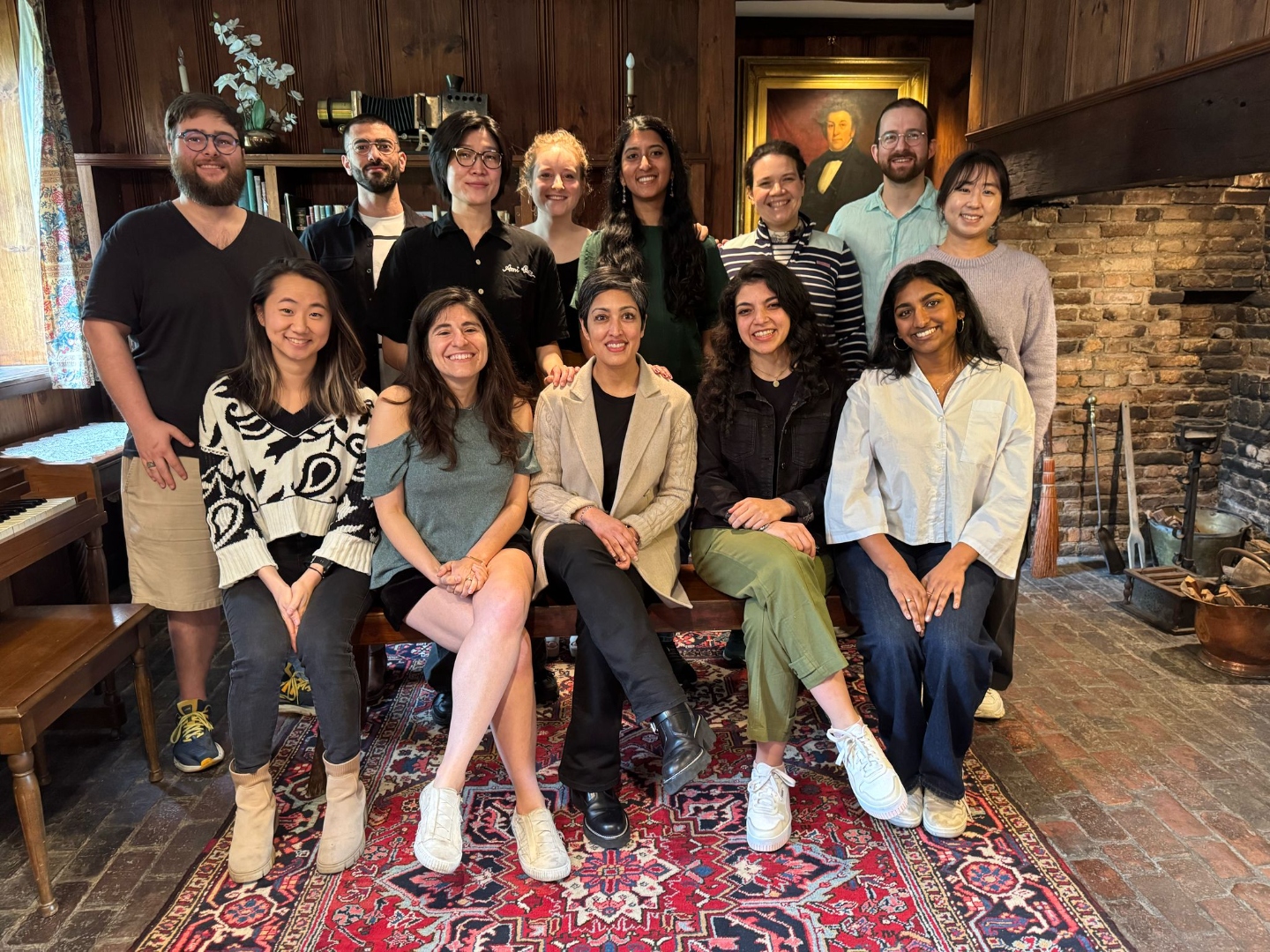
What is the role of human intelligence in the age of artificial intelligence? This six-episode podcast series, recorded at Harvard's Berkman Klein Center for Internet & Society, examines the concept of intelligence through science, history, politics, and economics — and what AI reveals about the society we've built.
Dr. Rumman Chowdhury hosted a seminar series at the Harvard Berkman Klein Center for Internet and Society, open to a curated group of Harvard undergraduates, graduate students, and postdocs from across disciplines and recorded as a podcast.
Each episode is a live recording of a real seminar class — unscripted, unfiltered, and genuinely contested. The format is intentional: these are the debates that usually happen behind closed doors at institutions like Harvard, brought into public view. Listeners don't hear a polished panel; they hear a room of thinkers working through hard questions in real time, from a wide range of disciplinary perspectives.
Each episode investigates "intelligence" not as a mathematical or scientific absolute, but as a human-made construct — and follows that thread through science, history, politics, economics, and ultimately to the question of what artificial general intelligence really means.
Each episode is accompanied by a deeper written essay on Rumman's Substack, Thinking about Thinking — co-launching with each episode and going deeper into the academic literature and ideas from that week's seminar. The conversations here inspired a forthcoming book to be published by Bloomsbury Press.
Each episode is a live, unscripted recording of a real Harvard seminar class — the kind of candid, contested conversation that rarely makes it out of the room.
Wide Range of Perspectives
A curated group of Harvard undergraduates, graduate students, and postdocs from law, computer science, medicine, and the social sciences — bringing genuinely different viewpoints to each question.
Paired with the Substack
Each episode co-launches with an essay on the Thinking about Thinking Substack — going deeper into the literature and ideas from that week.
THE SERIES
The Episodes
(Artificial) Intelligence: A Scientific, Social, Political, and Economic Construct
01
EPISODE 1
AI, Intelligence & the Trouble with Benchmarks
What is intelligence — and why does our definition matter more than ever?
What is intelligence, really? This opening episode traces the industrial origins of IQ tests, interrogates how AI benchmarks may be new tools for old hierarchies, and asks: if we're on the wrong path to AGI, what would the right one look like?
"Intelligence isn't just the answer, it's the path to the answer."
Rethinking Intelligence Through Animals, Swarms & Sentience
From chimps to ant colonies: what non-human intelligence tells us about AI.
How have other fields studied intelligence in non-humans — from chimps to lobsters to ant colonies? And what does swarm intelligence tell us about AI's scaling ambitions? This episode blurs the boundary between intelligence and sentience.
"Maybe our fear of AI becoming like us is really a fear of ourselves."
Who decides what counts as intelligent — and who gets rights because of it?
The fraught history of defining human intelligence — and how we conflate intelligence with sentience. Edge cases: end-of-life care, infant cognition, fitness for trial. Intelligence matters because it ascribes rights.
"Intelligence can be perceived as a social construct because its definition, measurement, and value are shaped by cultural, historical, and contextual factors rather than being purely objective."
Intelligence has always been weaponized. What happens when AI enters that lineage?
Intelligence as a history of exclusion — used to exclude women, justify slavery, and deny citizenship. AI is the first time we are facing an intelligence ostensibly "greater" than ours, as defined by our own societal values.
"AI is the first time we are facing an intelligence 'greater' than ours — as defined by our own societal definition of value."
Coming Soon
05
EPISODE 5
Intelligence as an Economic Construct
When productivity becomes the measure of a mind, who gets left behind?
What is AGI? How has the definition evolved across researchers and corporations? This episode tracks OpenAI's fully economic definition — "all tasks of economic value" — and asks what happens when intelligence becomes synonymous with productivity.
"If we define intelligence — and therefore value — by a corporate construct, and link that construct to 'intelligence = rights,' what are the implications?"
Coming Soon
06
EPISODE 6
Artificial General Intelligence
We've mapped how intelligence has been used. Now: what do we actually want from AI?
What is it about "AGI" that's captured the imagination? Through the course of this series we've uncovered uncomfortable truths. Now: the ELIZA effect, the human impulse to anthropomorphize, and what a positive AI future might actually require.
"We've been here before — attributing personality, emotion, and understanding to machines. The question isn't whether AI is like us. It's whether we're willing to ask why we want it to be."
Coming Soon
THE VOICES IN THE ROOM
Seminar Participants
Each seminar brought together a curated group of Harvard community members whose expertise shaped the conversation. These are some of the thinkers who were in the room.
Dan Be Kim
Dan Be Kim is an AI Fellow and Translational Research Designer at the Center for Digital Thriving at Project Zero, Harvard Graduate School of Education, where she designs human-centered AI literacy programming for educators and learners. Her work explores what responsible and ethical AI use looks like in education, drawing on her technical background as a product manager and startup founder, and inspired by her exposure to various types of pedagogy across South Korea, India, the US, Canada, and Germany.
Nada Salem is a bioethics researcher and policy specialist. She earned a MSc in bioethics from Harvard Medical School, and a BSc in cellular and molecular biology from the University of Calgary. Her work examines the ethical and policy implications of emerging biotechnologies, including brain-computer interfaces and biocomputing. Nada has written about issues in research trials, neural implants, health data privacy and democracy, published in outlets including Canada's National Observer and Tech Policy Press.
Kristen is a law student at Harvard Law School. She previously worked on technology policy in the federal government.
Rod Moshtagi
Rod Moshtagi is a Master in Public Policy student at the Harvard Kennedy School, where his work focuses on the labor market effects of artificial intelligence and the policy tools governments can use to respond. Before graduate school, he was a consultant at PwC working on Responsible AI, helping clients think through governance, risk, and deployment of machine learning systems. His capstone research with Mila (the Quebec AI Institute) proposes an early warning system for AI-driven job displacement in Canada, and this summer he joins the Centre for the Governance of AI as a fellow working on the economic impacts of advanced AI.
Theodora (Theo) Skeadas is a PhD researcher at King's College London Department of War Studies, exploring the relationship between online and offline harms. As Head of AI Red Teaming at Humane Intelligence, she develops hands-on, measurable methods of real-time assessments of societal impact of AI models. She chairs the Advisory Board of All Tech is Human, and is Co-Chair of the Board of Directors at Integrity Institute. Theodora graduated from Harvard College with a B.A. in Philosophy and Government, and minors in Near Eastern Languages and Civilizations, Modern Standard Arabic, and Modern Greek, and Harvard Kennedy School with a Master in Public Policy.
Navya Ramakrishnan is a Harvard College student studying Computer Science and Mind, Brain, and Behavior and pursuing a concurrent master's degree, with interests in how AI systems shape human reasoning, decision making, and trust. Her work spans software engineering, applied machine learning, and research on high-stakes AI settings, including biomedical reasoning and large language models. After graduation, she will join Northslope Technologies as a Forward Deployed Engineer.
Kedaar C. Sridhar is a builder, entrepreneur, and AI Fellow at Harvard working at the intersection of education, social impact, and product innovation. He earned his B.S. in Computer Science from UCLA and his master's in Learning Design, Innovation, and Technology from the Harvard Graduate School of Education. He is the Co-Founder and Chief Product & Technology Officer of M7E AI, a platform using responsible AI to improve linguistic comprehension in K–12 math education, and Grantlytics, an AI-powered platform helping mission-driven organizations streamline grant discovery, writing, and management. His work focuses on building practical AI systems that expand access, improve decision-making, and create real-world impact.
Hannah Kim is an undergraduate at Harvard College studying Computer Science. She has worked in various AI contexts, from developing cancer diagnosis models to conducting Human Computer Interaction research and investigating failure modes in diffusion models at the Kempner Institute. She recently co-founded Boston Diffusion Day, the first academic symposium focused on diffusion modeling, and led WECode, the world's largest undergraduate-run women in tech conference.
Christine Hwang is an educator and learning designer who focuses on human-centered, research-informed design of digital and AI learning tools to support access to quality learning, especially among culturally and linguistically diverse students. Her background spans teaching, education research, and international development across the U.S., China, and Uganda. Currently, she supports faculty in online course development and AI literacy initiatives at the Teaching and Learning Lab at Harvard Graduate School of Education, where she earned her Ed.M. in Learning Design, Innovation, and Technology.
Chaerin Lim is a Harvard Kennedy School MPP with an interdisciplinary background in computer science, creative writing, and public policy. Her career has focused on bridging technical concepts and policy, translating technical issues to a general audience and crafting actionable policy recommendations on technology challenges. Her work at Kakao’s Policy Team developed her interest in the ethical design of technology and regulatory laws in Big Tech. Her passion for responsible AI governance has led her to the World Bank and the OECD AI team.
Charlie Pozniak is a Belfer Young Leader and Harvard Kennedy School MPP (STEM) graduate, where his research spanned the behavioral economics of algorithmic systems at Harvard Law School, the geopolitics of AI and emerging technology at the Belfer Center, and AI/ML for urban data at the Berkman Klein Center. He is the founder of g8keep, a platform building infrastructure for AI agents that dynamically optimizes model-compute allocation. Before Harvard, he read History at Oxford and balanced a professional rugby career in the English Premiership.
Kirthi Chigurupati is a Harvard College student studying Government with a secondary in Computer Science. As Chair of the Harvard Institute of Politics JFK Jr. Forum, she hosted weekly public conversations with figures including President Volodymyr Zelenskyy, Justice Stephen Breyer, and Dr. Anthony Fauci. Her experience spans political journalism at NBC's Meet the Press, legal and AI policy at the International Bar Association, and research on politics and marginalized groups at the Harvard Kennedy School. Her interests lie at the intersection of AI policy, tech law, and democratic governance.
Nelly Rousseau
Nelly Rousseau started her career as a Young Business Leader with Orange, the leading telecom operator in France, where she managed customer success, launched strategic partnerships for their first IoT solution and managed a $12 million portfolio in B2B sales. Exploring the intersection of technology and public policy at the Harvard Kennedy School of Government, she conducted research on digital regulation and taught internet governance. Nelly is passionate about harnessing the power of technology and shaping policies and markets to create positive impact at scale. Nelly holds a Masters from a top French business school and an MPA from Harvard.
SUBSCRIBE
Listen Wherever You Get Podcasts
Subscribe to stay up to date when new episodes drop. Each episode co-launches with a deeper written essay on the Thinking about Thinking Substack — subscribe there now to get the full series as it drops.
AI Safety Researcher · Founder, Humane Intelligence · Responsible AI Fellow, Berkman Klein Center 2024–25
Dr. Rumman Chowdhury is a leading voice on responsible AI, working at the intersection of technology, policy, and human rights. During her fellowship at the Harvard Berkman Klein Center for Internet and Society, she designed and led this six-class seminar series — recorded as a podcast — bringing together Harvard community members and students across law, computer science, medicine, and the social sciences.
Her work spans AI evaluation frameworks, algorithmic accountability, and the societal implications of emerging technology — grounded in the conviction that rigorous research must translate into public understanding and democratic action.
Recorded during Dr. Chowdhury's Responsible AI Fellowship at the Harvard Berkman Klein Center for Internet and Society, 2024–2025.
THE PRODUCER
Christopher Hooton
Thinking about Thinking was produced by Christopher Hooton. As a podcast creator, Christopher has produced multiple Apple and Spotify chart-topping series and been honoured by the Webby Awards. As a journalist, he is the former Culture Editor of The Independent and currently writing books for publishers Hachette and Bloomsbury. And as a filmmaker, he has written and directed for Film4 and is currently collaborating with Ridley Scott Associates on documentaries. He has focused professionally on the cultural sector, with a keen interest in how it is being affected by AI.